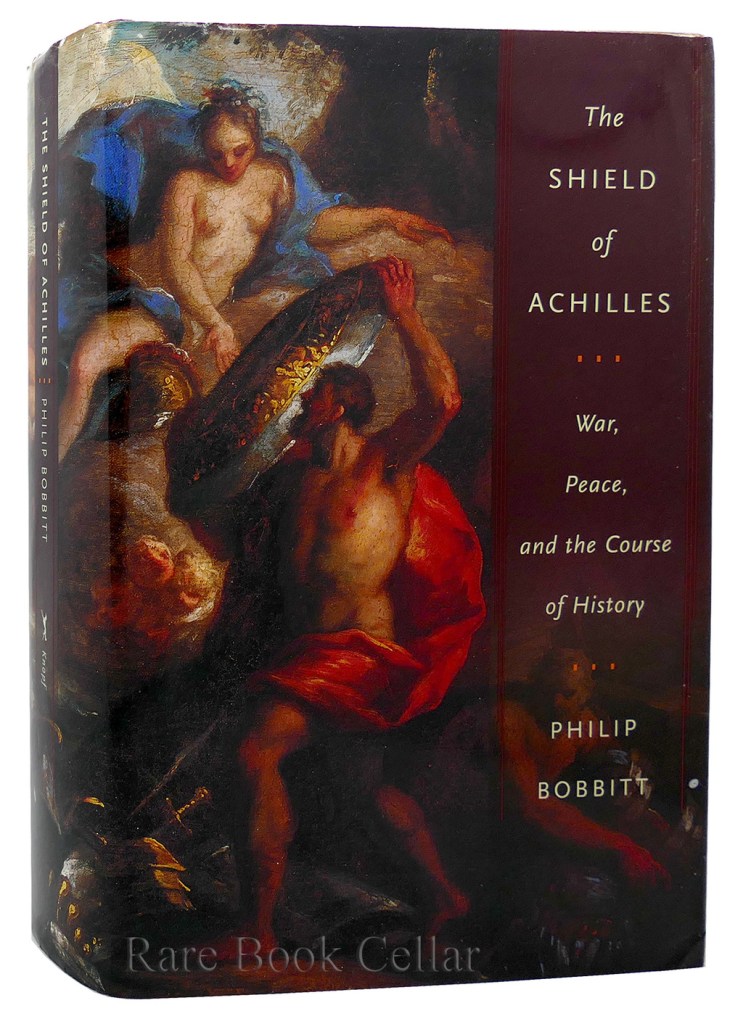
LIBRARIUM. The Shield of Achilles: War, Peace, and the Course of History by Phillip Bobbit, Part 1

This is a series of articles I wrote when I was studying history at George Wythe University.  This book was required reading.  These articles are my thoughts on various subjects covered in the book, with added updates as needed.  I highly recommend anyone interested in understanding modern events from an historical perspective to take the time to read this book.
THE STRATEGY OF ETHNIC CLEANSING

“Ethnic cleansing is thus not merely a political goal. It is a coordinated set of tactics in service of a well-thought-out military strategy…” (Phillip Bobbit, Shield of Achilles)

Most of the history of the world is the history of forced migrations and ethnic cleansing.  This is how it’s done.

Stage One:

Isolated terrorist-type attacks on rural populations, usually in response to some contrived “crime”, driving them from their homes and towns into “safe area” refugee cities, now filled with defenseless, hungry, displaced people.

Stage Two:

Besiege the refugee cities, cutting off supplies, and carry on a campaign of bombardment.

Stage Three:

Forced surrender of the refugee cities, kill all men of military age, rape the women to humiliate the population, remove the population to resettlement camps outside of their homeland.


If this pattern sounds familiar, it is because humanity has experienced it over and over and over again.  Genetic studies have shown that when a population is conquered, the men tend to be slain, but the women remain and future children bear the genes of the conquer and the ethnical characteristics are destroyed over time.

It is a sad commentary on the nature of power to corrupt mortal humans.  Lord Acton was right when he said, “Power tends to corrupt and absolute power corrupts absolutely. Great men are almost always bad men, even when they exercise influence and not authority; still more when you superadd the tendency of the certainty of corruption by authority.”

Below is a list of just some of the more well-known genocidal/ethnic cleansing events.   Tragically, there are many, many more . . .

Neo-Assyrian Deportations (9th–7th centuries BCE): The Assyrian Empire pioneered large-scale forced resettlements as state policy.  These mass deportations, affected an estimated 4 million people, including the population of Northern Israel (the “Ten Lost Tribes”) after the fall of Samaria in 722 BCE.  The earliest known example of ethnic cleansing.

Babylonian Captivity/Exile (597–538 BCE):  Thousands of Israelites from the Kingdom of Judah were resettled in Babylonia in 597 and 586 BCE, a form of selective deportation akin to ethnic cleansing.

Roman Destruction of Carthage (146 BCE): Rome besieged and utterly destroyed Carthage, killing most inhabitants and enslaving about 50,000 survivors. This genocidal form of ethnic cleansing effectively destroyed Carthaginian civilization.

Displacement of Native Americans (18th–19th centuries, United States): European settlers and later U.S. government policies, forcibly removed indigenous peoples from their lands through treaties, military action, and relocation to reservations.  This version of ethnic cleansing resulted in untold numbers of death, disease, starvation and the destruction of traditional social order.

Mormon Extermination Order (1838 – 1976): Missouri Executive Order 44, was an executive order originally issued by Missouri Governor Lilburn W. Boggs on October 27, 1838.  It was not rescinded until 1976, by then Governor Christopher Bond.  This ultimately led to the Church of Jesus Christ of Latter-day Saints leaving the United States for Mexico Territory in 1847.  Their settlement later became the state of Utah.

Armenian Genocide (1915–1916, Ottoman Empire): During World War I, the Ottoman government deported and massacred approximately 1.5 million Armenians, mostly Christians who were replaced by Muslims. This ethnic cleansing involved death marches, starvation, and killings.

The Holocaust (1941–1945, Nazi Germany and occupied Europe): The Nazi regime systematically murdered approximately 6 million Jews—two-thirds of European Jewry—through ghettos, forced labor, mass shootings, and extermination camps. It also targeted Roma, disabled people, Poles, Soviet POWs, and others, totaling around 11–17 million victims.

Nakba (1948, Palestine/Israel): During the 1948 Arab-Israeli War, approximately 750,000 Palestinians (about half the Arab population of Mandatory Palestine) were displaced from their homes in territories that became Israel. Israel officially attributes most departures to voluntary flight or war chaos. The event created a lasting refugee crisis, and with return denied, an ethnic cleansing of the areas involved.

Bosnian War (1992–1995, former Yugoslavia): Bosnian Serb forces, supported by Serbia, conducted widespread ethnic cleansing against Bosniaks (Bosnian Muslims) and Croats, involving forced expulsion, mass rape, concentration camps, and killings, meeting the criteria of ethnic cleansing.

Rwandan Genocide (1994, Rwanda):  From April to July 1994, Hutu extremists orchestrated the massacre of approximately 800,000–1 million people, primarily Tutsi but also moderate Hutu. These events were recognized as genocide by the International Criminal Tribunal for Rwanda.

Ethiopia-Eritrea Deportations (1998–2000, Ethiopia and Eritrea): Ethiopia deported around 75,000–80,000 people of Eritrean origin (many long-term residents or Ethiopian citizens by birth). These people faced asset freezes, family separations, and harsh conditions. Human Rights Watch identified Ethiopia’s actions as ethnic cleansing.

Rohingya Crisis (2017–ongoing, Myanmar): Myanmar’s military launched operations against the Rohingya Muslim minority in Rakhine State, involving village burnings, mass killings, rape, and forced displacement of over 700,000 people to Bangladesh. The U.N. described it as a “textbook example of ethnic cleansing”.

Uyghur Persecution (2017–ongoing, China): In Xinjiang, Chinese authorities have detained over one million Uyghurs and other Turkic Muslims in internment camps, subjected them to forced labor, sterilization, cultural erasure (e.g., destruction of mosques), and surveillance.

Tigray War Ethnic Cleansing (2020–2022, Ethiopia): In Western Tigray,  hundreds of thousands of Tigrayans were forced to suffer killings, rape, detention, and expulsions to homogenize the area. Both U.S. government and Human Rights Watch identified these actions as ethnic cleansing.

Gaza Conflict (2023–ongoing, Israel/Palestine): Following the October 7, 2023, Hamas attacks, Israel’s military response in Gaza has displaced over 1.9 million Palestinians (nearly 90% of the population), with widespread destruction and evacuation orders. Israel rejects these claims, stating operations target Hamas, with evacuations for civilian safety amid urban warfare.

I am reminded of a song by Bob Dylan called, “Blowin’ In The Wind”.

“How many roads must a man walk down
Before you call him a man?
How many seas must a white dove sail
Before she sleeps in the sand?

“Yes, and how many times must the cannonballs fly
Before they're forever banned?
The answer, my friend, is blowin' in the wind
The answer is blowin' in the wind

“Yes, and how many years must a mountain exist
Before it is washed to the sea?
Yes, and how many years can some people exist
Before they're allowed to be free?

“Yes, and how many times can a man turn his head
And pretend that he just doesn't see?
The answer, my friend, is blowin' in the wind
The answer is blowin' in the wind

“Yes, and how many times must a man look up
Before he can see the sky?
Yes, and how many ears must one man have
Before he can hear people cry?

“Yes, and how many deaths will it take 'til he knows
That too many people have died?
The answer, my friend, is blowin' in the wind
The answer is blowin' in the wind.”


Ultimately, the answer lies in all of us, and in none of us, unless we change our own hearts and minds, then seek to change the hearts and the minds of the people on the ground and speak up or take action at injustices we see in our spheres of influence.

Original version published on 17 February 2009.

Letters to Editors Archive: The Loss of American Neutrality and More.

A shorter version was originally written in April of 2003 (Quincy Valley Post-Register) Please see Epilogue below for some more recent thoughts in August 2024.

J. Reuben Clark, former US Undersecretary of State and former US Ambassador to Mexico once said, “America, multi-raced and multi-national is, by tradition, by geography, by citizenry, by natural sympathy, and by material interest, the great NEUTRAL nation of the earth.”  

Today America is experiencing the results of casting aside that tradition and has become embroiled in a War that has polarized our nation and the world.  

We have lost the spirit of Lady Liberty, who holds her lamp high to symbolize to the world that there is justice, peace, and mercy available to all who would choose to abide by the principles of the Constitution of the United States of America.  

We have lowered our standard of morality.

We have made citizenship a matter of financial gain rather than of honor.

We have squandered the blood of our young men and women warring in foreign nations, nations which often turn to bite the hands that feed them.  

My solution:

Let us return to our Great Tradition of independence and liberty, of economic freedom and prosperity, of justice and mercy.  

Let us return to the original intent of the Constitution.  Let us teach the principles upon which this nation was founded – that all mankind are created with the un-alienable rights to equality under the law, of economic opportunity, and the untouchable freedoms as enumerated in, but not limited by, the Bill of Rights.

Let us remember that these gifts were bestowed upon us by a benevolent Creator, not a government, that mankind cannot usurp nor deny those rights.  

We can regain our status as the torchbearer of representative government and liberty by remembering the above quote and working towards re-establishing that government through the political process, by voting our conscience, by electing moral and just persons to public office, and by educating ourselves about the issues placed before us each election. 

The End.

EPILOGUE: Whatever our position on the issues in this current election year, we face a critical decision which will affect all our futures — good or bad, easy or hard, war or peace. Rather than taking sides and playing an “I win/you lose” game, perhaps we should try the Principle approach and a “blind test”, that is judging candidates, issues, and national policy by the following standards:

  • Does the (candidate, issue, policy) promote Liberty or Tyranny?
  • What has been the history of each (candidate, issue, policy)? Have their historical and documented actions or results promoted Liberty or Tyranny?
  • Governments do not create wealth, they redistribute the wealth of others, usually taken by threat of force through taxation. Does the (candidate, issue, policy) take more wealth or less wealth?
  • Do the (candidates, issues, or policies) promote a free-market economy (Liberty) or do the regulations exceed that which is necessary to protect the lives and liberty of consumers (Tyranny)?
  • Does the candidate represent the people he or she will serve, or do they represent their financial backers, or their own personal agenda or the agenda of their declared party?

May the candidate with the highest score get your vote and win, without regard for party affiliation or fear of the enemy. It’s the only way to start swinging the pendulum back towards the promise of American Liberty in its purest form.

Independence Day 2024: What Legacy are We leaving for our Ourselves and Our Posterity?

On November 19, 1863, President Abraham Lincoln gave one of the most famous speeches in American history following the Battle of Gettysburg during the War Between the States.  Whether you are fan of Abraham Lincoln’s political decisions or not, in that moment in time and in that place, he spoke words which are timeless in their sentiments.  As I was recently re-reading these great words, the following thoughts came to me regarding the state of America in our day.

237 years ago, the Founding Fathers brought forth on this continent a new nation, conceived in Liberty, and dedicated to the Proposition that All Mankind are created Equal. They understood that there are certain un-alienable rights which belong to every human being from conception until natural death.  Such un-alienable rights may not be transferred from person to another person or entity, without the express permission of those to whom the rights belong, that is We, the People.  Among these rights are Life, Liberty, and the pursuit of happiness.  The government they created is not intended to either usurp rights or bestow rights.  It can only have jurisdiction over that portion of those pre-existing rights which We, the People, allow them to temporarily control.  We can take the power of government back at any time, and we can give them other powers at any time, through the process provided for in Article V of the U.S. Constitution, and through the principle of Civil Disobedience.  Government, however, cannot lawfully dictate the Rights of the People by its own power—not by unconstitutional legislation, or by executive action, or through regulation and policy, or by judicial opinions.  It can neither create rights nor destroy rights.   Its one and only job is to protect pre-existing rights.

“We the People of the United States, in Order to form a more perfect Union, establish Justice, insure domestic Tranquility, provide for the common defence, promote the general Welfare, and secure the Blessings of Liberty to ourselves and our Posterity, do ordain and establish this Constitution for the United States of America.” (Preamble to the United States Constitution)

Now we are engaged in a great political war, “testing whether this nation, or any nation so conceived and so dedicated, can long endure”. 

In the past 237 years, we have met our fellow Americans, as well as the soldiers of many nations, on many battlefields, both domestic and abroad.  Today we are meeting those who are opposed to Liberty on the new battlefields of social media, controlled mainstream media, in the courts and on the very streets of America.  We have strayed from our principles; indeed, we have been sidetracked by the very prosperity created by those principles.  We have so much “free time and abundance” because of that prosperity, we waste ourselves and our resources by focusing on self-gratification and material things more than we value things of the mind and heart.  When someone does stand up against the tyranny, we berate and belittle these new liberty warriors, those who take off their masks and refuse to obey unlawful and unconstitutional orders from bureaucratic servants.  Yet, the very air of liberty we breath was bought and paid for, and is still being bought and paid for by those sacrifices made on not only the traditional battlefields but the modern social battlefields as well. 

President Lincoln was speaking only of Gettysburg when he said, “we can not dedicate—we can not consecrate—we can not hallow—this ground. The brave men, living and dead, who struggled here, have consecrated it, far above our poor power to add or detract.”   But I say, we cannot dedicate nor consecrate, nor hallow this land of Liberty, our beautiful America, unless we pay the price the men at Gettysburg paid on both sides of that conflict.

Lincoln went on to say, “The world will little note, nor long remember what we say here, but it can never forget what they did here. It is for us the living, rather, to be dedicated here to the unfinished work which they who fought here have thus far so nobly advanced. It is rather for us to be here dedicated to the great task remaining before us—that from these honored dead we take increased devotion to that cause for which they gave the last full measure of devotion—that we here highly resolve that these dead shall not have died in vain—that this nation, under God, shall have a new birth of freedom—and that government of the people, by the people, for the people, shall not perish from the earth.”

Another President, Franklin Delano Roosevelt, from political party other than that of President Lincoln had some words of wisdom for us as well.  He said, “There is a mysterious cycle in human events. To some generations much is given. Of other generations much is expected. This generation of Americans has a rendezvous with destiny.”  Whether you agree with his political decisions or not, there is truth to be found here.

The cycle of American Liberty has turned again.  We are the inheritors of the blessings of Liberty, but we are also the destroyers unless we can stop the insanity.  It is for us and no one else, “The buck stops here” as President Harry S. Truman said.  It is our generational duty to those who come after.  We must be “dedicated to the great task remaining before us, we must resolve that this Republic and those who built it, sustained it, bled for it, will “not have done so in vain”.

Let us all humble ourselves in prayer, then put our shoulders to the wheel.  Let us work however, and wherever we may best serve with the God-given talents with which we have each been blessed, in our homes and our communities.  Only then will we experience “a new birth of freedom” and that this “government of the people, by the people, and for the people, shall not perish from the earth.”  So help us, God.


The Gettysburg Address

Four score and seven years ago our fathers brought forth on this continent, a new nation, conceived in Liberty, and dedicated to the proposition that all men are created equal.

Now we are engaged in a great civil war, testing whether that nation, or any nation so conceived and so dedicated, can long endure. We are met on a great battle-field of that war. We have come to dedicate a portion of that field, as a final resting place for those who here gave their lives that that nation might live. It is altogether fitting and proper that we should do this.

But, in a larger sense, we can not dedicate—we can not consecrate—we can not hallow—this ground. The brave men, living and dead, who struggled here, have consecrated it, far above our poor power to add or detract. The world will little note, nor long remember what we say here, but it can never forget what they did here. It is for us the living, rather, to be dedicated here to the unfinished work which they who fought here have thus far so nobly advanced. It is rather for us to be here dedicated to the great task remaining before us—that from these honored dead we take increased devotion to that cause for which they gave the last full measure of devotion—that we here highly resolve that these dead shall not have died in vain—that this nation, under God, shall have a new birth of freedom—and that government of the people, by the people, for the people, shall not perish from the earth.

Abraham Lincoln


Painting Note: Lincoln at Gettysburg, by Albion Harris Bickwell, 1837-1916. Lafayette College. David W. Coulter, Photography.

LETTERS TO THE EDITOR ARCHIVES: Responsible Taxation

Originally published 9 February 2011 in the Spokesman-Review, Spokane County, Washington.

TAXES OKAY WITH STRICT RULES

Shawn Vestal recently (Jan 28) wrote a column about the group “Citizens for Responsible Taxation”. He said, “Beal, Montgomery, and Alton are Citizens for Responsible Taxation, although everyone knows there is no such thing as responsible taxation.”

Mr. Vestal, though attempting to be humorous, does bring up a good point. Is there such a thing as “responsible taxation”?

How does government propose funding government schools or agencies, if not by some form of taxation? State legislators and Congress all seem to believe in taxation. As a matter of fact, so did the Founding Fathers who wrote the U.S. Constitution. In fact, again, they believed in responsible taxation so much they set up some pretty strict rules about it, which have been consistently ignored by lawmakers who sponsor porkbarrel projects or fund unconstitutional programs, creating a climate of unreasonable taxation at every level of government.

The efforts of three citizens exercising their First Amendment right to Free Speech in order to educate the public on their point of view opposing a school bond is equally valid and deserves equal respect as the speech of those who may be in favor of it.

Karen Murray; Quincy, Washington

TESTIMONY AND THE BALLOT BOX

Bearing witness is an essential component of being a citizen, whether a citizen of a religious society or a citizen of a country or a nation. Every aspect of life relies upon either the testimony of others or the testimony of our own observations and experiences.

It’s that time of year again, Election Season, time when everyone seems to lose their minds.  Vote for me, I’ll keep the world safe with war – war on drugs, war on the climate, war against anything or anyone you don’t like.   No, No, vote for me and I’ll make sure you have anything you want; we’ll just print more money and tax anyone who have more than you until no one has more than anyone else, a true utopian society.  But wait, wait, wait, vote for me and I will set you free – get out of jail free (no matter what your crime), free from accountability when you run amok in the streets rioting and looting, free of all those people with pesky opinions you don’t like, we’ll lock them up instead!  Honesty and Integrity become a rarity, Propaganda overtakes reason and fills the airwaves instead of hard facts and accurate reporting.  Calgon, take me away!

(Cut away from the chaos of the modern world to my quiet office overlooking the woods somewhere in rural Alaska…)

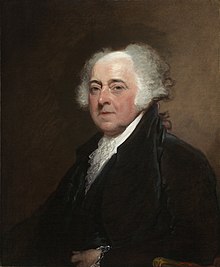
There is one thing that brings peace to an election troubled mind – – knowledge that is a better way, if we just open our minds to the idea that virtue and principles matter in America’s Constitutional Republic.  John Adams, second president of these united States of America, said “Our Constitution was made only for a moral and religious people.  It is wholly inadequate to the government of any other.”   He has a lot to say on the matter.  You can read more of his quotes here.

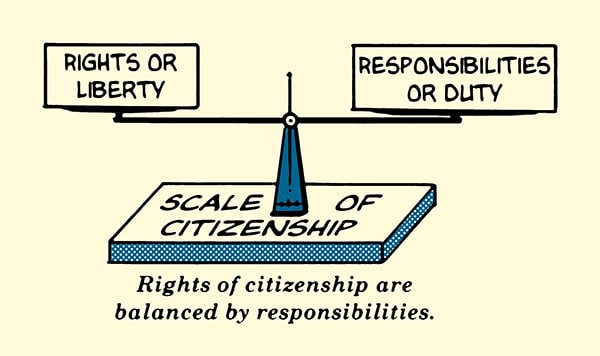
What is morality?  In Noah Webster’s 1812 American Dictionary of the English Language, morality is defined thus, “The doctrine or system of moral duties, or the duties of men in their social character; ethics.”  Ethics is defined as, “The doctrines of morality or social manners; the science of moral philosophy, which teaches men their duty and the reasons of it.”  Finally, religious can be defined in many ways, but in applying it to America’s constitutional republic, I believe it means “Exact; strict; such as religion requires” in upholding the moral and ethical foundations of that republic.  One of the basic moral foundation stones is the concept of Rights and Duties.

Rights and Duties

For a few years, I was blessed to teach the basics of the Constitution to elementary school-age children during the annual Constitution Week, as required by education laws in Washington State.  One of the most important interactions occurred when I had three or four children come up and hold some signs with the name of a “Right” on one side and the corresponding “Duty” on the other.  Most of the children clearly understood about Rights, as children do – “I have the right to my room”, “I have the right to my toys”, “I have the right to eat”, etc., but Duties are harder — “I have the duty to keep my room clean, “I have the duty to take care of my toys”, I have the duty to help prepare meals or to wash the dishes.”   In regard to the Constitution, we would talk about the Right to a Jury Trial, for example, and the subsequent Duty to Serve as a Juror.  If you expect a good, intelligent jury to judge a case you might be involved in, then you have the Duty to be such a juror for someone else.    Or perhaps, you want the Right to worship God according to your own conscience, then you have the Duty to allow others the same privilege.  And so on . . .

The Right to Vote is no different.  It also has an attached Duty.

Voting is a Sacred Duty

As Americans who are used to a lot of free speech and complaining about this or that all the time, we tend to forget that free speech and the ability to actually have a voice in our republic are blessings which most of humanity throughout history has not had the privilege of experiencing.  Indeed, many peoples in the world today do not have that privilege.  It is a Duty that we, as Citizens of the American Constitutional Republic should exercise wisely.

Most politics these days is gamesmanship, seeing who can win or lose at all costs, telling whatever lies and deceptions are necessary to win over the “enemy”.  It is all about the game and very little about what is moral or ethical.  The lie is perpetuated that the government will give you this right or that right, or this benefit or that benefit, without considering any facts or any consequences.  Fear and hatred of the opposition becomes the motivating factor and the spiral downward to lesser and lesser moral and ethical choices has let us to the chaotic, warlike rhetoric and behavior seen in the current Election Season.  It’s time for a real change.  It’s time to return to a sense of Duty based upon principle rather than personality.  It’s time to learn that voting is really a Sacred Duty to ourselves, and our posterity for generations to come.

Voting is a form of “Bearing Witness” and a “Testimony”

Because I feel I have a Sacred Duty to vote, I feel I must do my due diligence to make sure that the candidate in question meets the moral and ethical standard required to serve his or her constituents in the American Constitutional Republic.  You will probably have your own dream list for a candidate, but here are some of the things I look for:

  • Do they understand the concept of a constitutional republic and are they committed to it?  Do they understand the Law of Sovereign Liberty and are willing to defend it?
  • Do they have a record of keeping oaths and covenants, that is, have they shown integrity in their business and personal life? No legal entanglements or history of criminal behavior?  Keeping their marriage vows? Have they served in the military or volunteered to serve others, either personally or in an organization?
  • Are their core principles in line with the principles of the Declaration of Independence, the U.S. Constitution, and the Bill of Rights? Are their core principles in line with their state constitution?
  • Have they shown fiscal responsibility in their personal life?  Are their proposals for change fiscally responsible?
  • Do they believe that people are first self-governing, and that the state and federal governments support the people in their efforts to provide for themselves rather that regulate him or her out of business with overbearing rules and policies?
  • Do they believe that the proper role of government is to protect rights and that government has no power to either bestow rights or prevent the free exercise of rights unless those rights are used to harm others or to commit a crime?
  • Recognizing that no one is perfect, does the candidate show an ability to learn from mistakes and move forward once an error is pointed out?
  • Does the candidate have experience with organizational or business budgeting and financial decisions?  Do they know how to be fiscally responsible?
  • Do they care about serving the people in their district or do they only care about serving themselves and their future ambitions?

Once these questions are answered, I am ready to fill in the circles on my ballot.  When I do, I am bearing my witness that the candidate I have chosen meets most of my criteria and that I feel confident they will do their best to serve wisely.  I am also testifying to my children and grandchildren that I have lived up to my Duty as a Citizen to delegate a limited portion of the sovereign authority invested in by virtue of my birth on this planet, trusting that that candidate, when elected, will work to preserve and maintain their future liberty, as well. If not, I will work to remove them from office at the next election or by a call for his or her resignation, showing just cause for doing so.

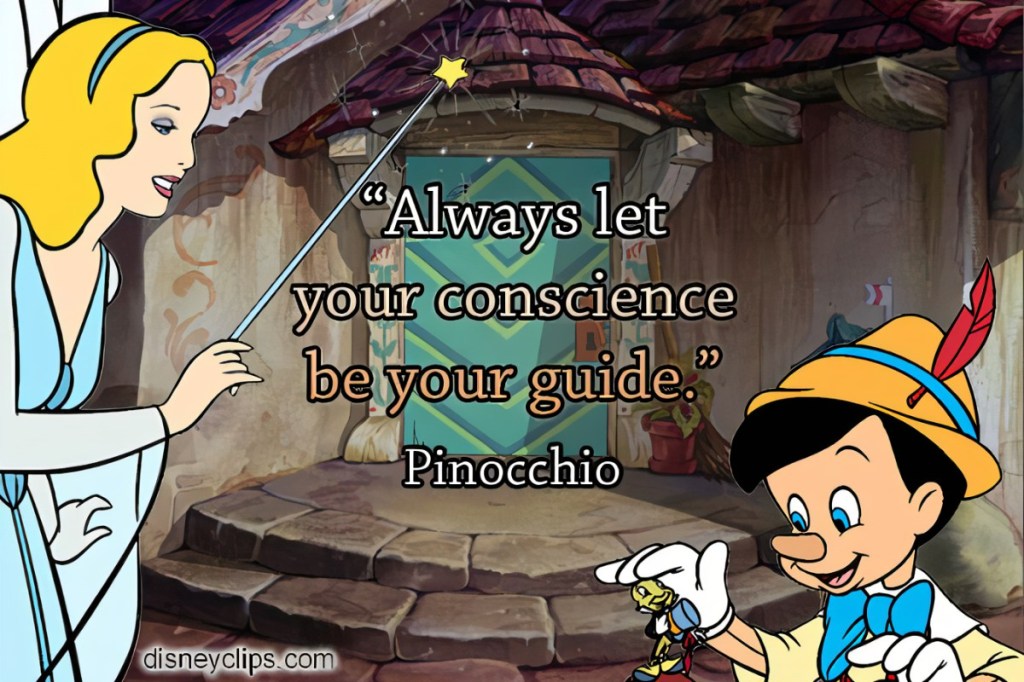
Always Let Your Conscience Be Your Guide

As I child, my first understanding of following my conscience came from the song sung by the character of Jiminy Cricket in Disney’s animated classic “Pinocchio”.  The Blue Fairy give the wooden puppet Pinocchio a conscience and Jiminy Cricket is always there to remind him to do so. 

Ranked Choice Voting is not a conscientious option for me.  In my mind, the best possible choice is still the best possible choice.  Diluting the best possible by spreading votes over lesser qualified candidates will only result in a continuation of the downward spiral, and the dumbing down of the American Constitutional Republic.  All candidates are not equal in terms of their qualifications or commitment to protect the Rights of the People against the government they wish to be a part of. Nevertheless, I believe God gave us the freedom to choose in the Garden of Eden.  What each of us may choose to do with that choice is ultimately between He and Me or He and Thee. 

What Do I Do if No Candidate Meets My Criteria

In the event that my conscience will not allow me to vote for any candidate listed, I choose to write in the name of some one I do trust, or I write “none of the above”, or I simply leave it blank.

John Adams also said, “Government is instituted for the common good; for the protection, safety, prosperity, and happiness of the people; and not for profit, honor, or private interest of any one man, family, or class of men; therefore, the people alone have an incontestable, unalienable, and indefeasible right to institute government; and to reform, alter, or totally change the same, when their protection, safety, prosperity, and happiness require it.”

May you be blessed with a clear mind as you make your own decisions this year and always let your conscience be your guide.

Ranked Choice Voting and the Constitutionist

A great experiment is taking place in Alaska this election season. Ranked Choice Voting (RCV) is being promoted as giving a greater voice to all political perspectives. All votes will count, they tell us, but the actual outcome will be no different than the traditional non-ranked voting. Principle will succumb to expediency, and the same fear that the enemy is going to win will determine the outcome.

Winston Churchill said, “You may take the most gallant sailor, the most intrepid airman or the most audacious soldier, put them at a table together – what do you get? The sum of their fears.” 

Elections in America are the same. Two party voters often make choices based on the sum of all their fears:  Republicans fear Democrats taking power, Democrats fear Republicans taking power. Each person self “ranks” his or her own choice in primary election by who they think has the best change of defeating “the enemy,” even if the candidate chosen does not share the same principles as the voter.

Alternative party or independent voters, tend to choose candidates based on principle, in spite of the fact that their chances of winning are greatly diminished by the Fear Factor of the two-party voters.

What is Ranked Choice Voting?

In traditional voting, the voter selects one candidate in each category and whichever candidate get the most votes is then elected to serve a particular office.

Ranked Choice Voting in Alaska provides primaries in which the top four vote getters move on to the general election. The voter ranks the candidates first, second, third, or fourth out of an unknown number of certified candidates. On the first round of voting, if no single candidate has achieved 50% plus one number of votes, then the least vote-getting candidate is eliminated and his or her votes go to the third choice of the individual voter. This creates the second round.  The process continues with the lowest vote getter being eliminated and re-distributed until one candidate eventually achieves a majority.  The hope is that this candidate will have been selected in such a way that will unify the majority of the electorate, as well as opening the door for segments of the population who often feel dis-enfranchised by the current system to feel that they had a voice in the election.

For the Constitutionist voter, however, RCV continues to subdue their voice because it does nothing to correct the unconstitutional two-party election system currently operating in America, nor the mindset of the average voter who has been conditioned to believe that this is how it has always been and will always be.

The Constitutionist Ranked Choice Voting System

Voters, like myself, who support a return to the original intent of the Constitution of the united States of America, have their own version of RCV.  We rank each individual candidate by the principles they espouse rather than party affiliation before we even get to the ballot box.

  1. Is the candidate legally qualified by federal and state law to hold the office in question?
  2. Does the candidate seem to know and understand the principles and guidelines found in the federal Constitution and in their respective state Constitution?
  3. Does the candidate appear to have integrity and honor in his or her personal and professional life?
  4. Does the candidate seem to have the knowledge of how governmental organizations operate? (Robert’s Rules of Order, the legislative process, etc.)
  5. Does the candidate understand that the Constitution restricts and limits the actions of lawmakers to specifically defined powers?
  6. Does the candidate understand that the Constitution protects the rights of the people, who hold all natural rights within their persons, and that the Constitution does not bestow rights because it does not have the power to create rights?
  7. Is the candidate committed to his or her oath of office, that is, to support the Constitution, and are they willing to be held accountable to that oath by their constituents?
  8. Is the candidate willing to defend the Constitutionally protected rights of his or her constituents against encroachment by other elected officers or through the legislative and regulatory processes?

Once these boxes in the Constitutionist’s personal Ranked Choice Voting test is done, then we can look at more specific issues for further refinement of our choice.  Each Constitutionist decides which items are of more importance to his or her conscience and ranks accordingly. The Constitutionist sees his or her vote as a sacred duty and stewardship to preserve liberty for future generations.

Finally, the Constitutionist will choose only the candidates who meet the criteria above. If that is only one per election, then one it is, for it is the principle that matters in the long term. Sometimes the Constitutionist might have to select “None of the Above”, if that is an option, or not cast a vote for any of the candidates. Voting for the lesser of two, or three, or four candidates, will only net the voter lesser candidates, not greater.

Tips

Whatever method you choose to vote or to rank the candidates, don’t forget to check out the official write in candidates, as you may find a great candidate among them.

Voting your conscience will not only help you sleep better knowing you made the best choice you could, it will also lift you up out of the political street battles which rage on social media and television news programs.  You will be able to see the issues more clearly and see what the best solutions might be, when your sight is no longer blurred by the fog of political rhetoric.

Do your homework.  Researching candidates and issues has never been easier in the history of the world.  Take advantage of it.

Support your chosen candidate with a nice note or a contribution. Running for office is difficult and can be expensive.

Finally, remember Fear is not a Factor when Faith and Commitment prevail.


This Constitutionist’s Pre-Ranked Vote Choices for the 2022 Alaska Primaries:

U.S. Representative: Chris Bye, write-in (www.itstimealaska.com)

U.S. Senator: Karl Speights (https://karlspeights4alaskaussenate.com/)

Alaska State Senate, District N: Scott Clayton (https://www.claytonforaksenate.com/)

Alaska State Representative, District 27: David Eastman (https://davideastman.org/)

RING OUT WILD BELLS:  A Message For Our Day


Every first Sunday in January our church sings the hymn, “Ring Out Wild Bells”.  Its music is haunting, but the lyrics have always seemed strange to me, and as I discovered, we only sing three stanzas of the original poem.  I’ve often wondered what it means.  Recently, while researching the idea of Father Time and New Year celebrations in general, I came across the full lyrics of this poem by Alfred, Lord Tennyson. Pondering his words, I found a deeper understanding, which seems eerily applicable to our world today.

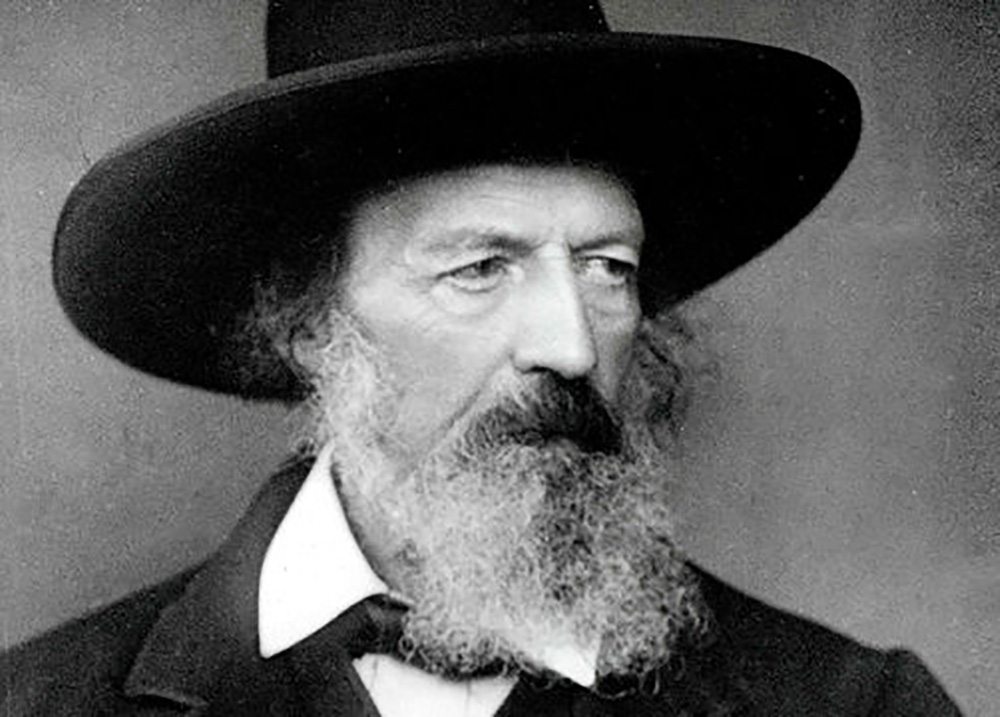
Alfred, Lord Tennyson

Alfred, Lord Tennyson (a Baron), lived from 1809 – 1892 in England.  He was poet laureate of the United Kingdom for most of Queen Victoria’s reign.  He is famous for several works, including “Charge of the Light Brigade”, “The Lady of Shalot”, and “In Memoriam”.   “Ring Out Wild Bells” is a section of “In Memoriam” which Tennyson wrote following the death of his close friend, Arthur Hallam.  Hallam was also engaged to Tennyson’s sister and died unexpectedly when he was 23 years old.  If you want to know more, a good biography of Tennyson can be found at internetpoem.com.

Wild Bells

In Britain, the ringing of church bells for special occasions has been a tradition since the early Christian priests rang a handbell to call the faithful to meetings, about 450 a.d.   Over time, bells became “tuned” and compositions written for bell ringers.  Wild bells (with no particular pattern) would be rung in times of danger or joy. 

According to Wikipedia: “It is an accepted English custom to ring English Full circle bells to ring out the old year and ring in the new year over midnight on New Year’s Eve. Sometimes the bells are rung half-muffled for the death of the old year, then the muffles are removed to ring without muffling to mark the birth of the new year.”

Father Time

I searched high and low for a good, comprehensive article about the concept of Father Time.  The best documented article can be found at Wikipedia, and I highly recommend it if you’d like to know more. 

Father Time seems to be an ancient symbol of Time, reaching back to the Greek male god of Chronos, or possibly a more ancient persona.  Tennyson’s use of the pronoun “he” when referring to the old year (“let him die”) reflects this connection.

Time is also a symbol of Truth.  Quote from the article: “Time (in his allegorical form) is often depicted revealing or unveiling the allegorical Truth, sometimes at the expense of a personification of Falsehood, Fraud, or Envy. This theme is related to the idea of veritas filia temporis (Time is the father of Truth).”

“Ring Out, Wild Bells”

In this poem, Tennyson touches upon obvious truths and offers solutions.  See if you can identify them for yourselves as you read each stanza below.  Listen to this beautiful rendition of the full song by the Croft Family.  The poem is so popular in Sweden that each year people gather to listen to readings of it as part of their New Year’s celebrations.

Ring out, wild bells, to the wild sky,
   The flying cloud, the frosty light:
   The year is dying in the night;
Ring out, wild bells, and let him die.

Ring out the old, ring in the new,
   Ring, happy bells, across the snow:
   The year is going, let him go;
Ring out the false, ring in the true.

Ring out the grief that saps the mind
   For those that here we see no more;
   Ring out the feud of rich and poor,
Ring in redress to all mankind.

Ring out a slowly dying cause,
   And ancient forms of party strife;
   Ring in the nobler modes of life,
With sweeter manners, purer laws.

Ring out the want, the care, the sin,
   The faithless coldness of the times;
   Ring out, ring out my mournful rhymes
But ring the fuller minstrel in.

Ring out false pride in place and blood,
   The civic slander and the spite;
   Ring in the love of truth and right,
Ring in the common love of good.

Ring out old shapes of foul disease;
   Ring out the narrowing lust of gold;
   Ring out the thousand wars of old,
Ring in the thousand years of peace.

Ring in the valiant man and free,
   The larger heart, the kindlier hand;
   Ring out the darkness of the land,
Ring in the Christ that is to be.

My Personal Impressions

The first two stanzas seem to be about letting go of the past and freeing yourself to more fully experience the future.  Always good advice, and may reflect the tradition of New Year’s Resolutions, as well.

In the third stanza, Tennyson advises us to overcome our grief for those who have passed on, and to stop arguing over who is rich and who is poor.  His solution: seek redress for everyone who is grieving, rich or poor for grief is universal.  Redress means to set right or remedy a situation.  We have seen countless examples of grieving in 2021 and also countless acts of mercy by those attempting to ease the grief or pain of others, a timeless principle of compassionate outreach.  Jesus Christ said, “Inasmuch as ye have done it unto the least of these my brethren, ye have done it unto me.” (Matthew 25:40).

The fourth stanza appears to address political issues, something we have also had our fair share of in 2021.  I am weary of America’s corrupt political system.  We need to return to the higher road of moral political virtue in all areas of life.  Using the definitions found in the 1802 Webster’s Dictionary, both the Framers of America’s constitutional republic and Tennyson would have defined “moral” and “virtue” thus: Moral is “Relating to the practice, manners or conduct of men as social beings in relation to each other, and with reference to right and wrong. The word moral is applicable to actions that are good or evil, virtuous or vicious, and has reference to the law of God as the standard by which their character is to be determined. The word however may be applied to actions which affect only, or primarily and principally, a person’s own happiness;” and, Virtue is “Moral goodness; the practice of moral duties and the abstaining from vice, or a conformity of life and conversation to the moral law. In this sense, virtue may be, and in many instances must be, distinguished from religion”.  Yes, a return to moral and virtuous behavior in political life will lead to “purer laws”.   2022 is an election year.  Being moral and virtuous in our personal lives, and choosing moral and virtuous leaders, is the only path towards the restoration of a simpler, wiser, more peaceful America.

Tennyson mourns the lack of compassion humans show towards one another in the fifth stanza.  Daily news headlines in our time reflect this tendency, but there is hope.  Occasionally a story appears of how one individual saw a danger or a need and took action to help someone in distress.  The poet is asking us to shake off the negativity of the time and embrace the spirit of living life to its fulness, in spite of our trials and woes.  The role of a minstrel in ancient times was to uplift his audience with inspiring epic poetry and songs to liven the heart.  Psalm 100 says it best: “Make a joyful noise unto the Lord, all ye lands.  Serve the Lord with gladness: come before his presence with singing. Know ye that the Lord he is God: it is he that hath made us, and not we ourselves; we are his people, and the sheep of his pasture. Enter into his gates with thanksgiving, and into his courts with praise: be thankful unto him, and bless his name. For the Lord is good; his mercy is everlasting; and his truth endureth to all generations”.

The sixth stanza seems to also be right out of the headlines, as Tennyson berates false nationalism and racial arrogance.  Instead, he asks us to seek the common ground of humanity based upon high principles of truth, justice, and compassion.  As Christ said, when asked what is the greatest commandment, “Thou shalt love the Lord thy God with all thy heart, and with all thy soul, and with all thy mind. This is the first and great commandment. And the second is like unto it, Thou shalt love thy neighbour as thyself. On these two commandments hang all the law and the prophets’” (Matthew 22: 37-40).  It is not your nationality or ethnicity which matter, it is how you treat one another within the bounds of moral and civil law, which has its root in the morality and virtue of the individual.

Wars and rumors of wars, global pandemic, and materialism are the subjects of the seventh stanza, -.  We seem to be a reactionary people, always rushing to put out this fire or that fire, with no real, logically thought out, principled plan of action.  We have forgotten what our common principles are.  Tennyson seeks for the peace of a thousand years, a millennial peace looked forward to by prophets both ancient and modern, but that peace must be based upon truth.  Mankind must understand self-governance in order to govern communities and nations.  Joseph Smith stated it best when asked why there was no crime in Nauvoo, the city built by the Latter-day Saints in Illinois.  He said, “I teach them correct principles and they govern themselves.”

In A Nutshell: The Eighth Stanza

Ring in the valiant man and free,
   The larger heart, the kindlier hand;
   Ring out the darkness of the land,
Ring in the Christ that is to be.

The New Year of 2022 is open to all possibilities, good and bad.  Ultimately, it is how we govern our own lives that will matter most.  To be valiant and free, to show compassion to those we may encounter, these are the basic principles that will “ring out the darkness” and ring in the Light of Christ.  Then we may experience the thousand years of peace, which Tennyson longed for in his lifetime.

A conversation between Frodo and Gandalf in the Lord of the Rings seems appropriate here. “I wish it need not have happened in my time,” said Frodo.  “So do I,” said Gandalf, “and so do all who live to see such times. But that is not for them to decide. All we have to decide is what to do with the time that is given us.”  

What will you do with the time and circumstances that are given to you?

Happy New Year, One and All!  It’s going to be a great adventure!  

Is This Not How LIBERTY is Lost?

Crises come and Crises go, it is a law of Nature, as History shows.  Will we do this every time we face a crisis from now on?

With the passage of the $2 Trillion Corona Virus Relief Stimulus legislation, Congress is basically using the tax money paid in by the American People for many generations as collateral for giving the people back a portion of their own money (taken from them by the force of government) while driving the nation deeper and deeper into debt for the sake of very temporary security and safety.  Crises come and Crises go, it is a law of Nature, as History shows.  Will we do this every time we face a crisis from now on?

It is like parents taking out credit cards in their children’s names and charging them to the full extent of their credit, printing monopoly money on their home printer and using that to pay the debt with the understanding that the children and their grandchildren, and then their grandchildren, will earn enough to pay it all, given enough time and income.  Buy now and future generations will pay later.  I call that fraud, theft, and a reverse Ponzi scheme.  Congress calls it business as usual.

I  personally think we should hold China accountable for their withholding of vital information about the virus by withholding interest payment on all the US Treasury Bonds and other financial instruments China may hold, confiscating all their assets on United States soil, sell those assets, and use that money as a direct payment of the debt we are racking up.  If China retaliates by flooding the market with US bonds, then We the People sell our shares in Chinese companies, buy those bonds and invest in our own country.

If we don’t find a way to reduce our debt and stop printing fiat money that has no gold or silver reserves to back it up, we are in for far more trouble than we face with this current crisis.

I must ask you… is this not how LIBERTY is lost?

Do What is Right, Let the Consequence Follow

4399655f9862fe2e7bf227af7c43a87eThe battle for liberty and freedom is a constant struggle against the forces of tyranny and coercion. The Grand Yin/Yang of the universe. It permeates everything in our lives. We push forward towards understanding and promoting liberty, and tyranny pushes back. All we can do in our limited lifetime is seek to understand the truth of all things, take a stand, be immovable, and face the consequences of our actions, good or bad.  The cumulative actions of all of us, acting individually, swings the pendulum towards one pole or another at any given time in history.  What direction are you pushing?

Do What is Right, Let the Consequence Follow

It has become my custom to sing a hymn each morning to start my day. Not only to I get to learn the music but I also get to learn the lyrics, and ponder them. Last week it was an old hymn called, “Do What is Right”.

One morning the thought occurred to me that the song seemed to be talking about slavery and I wondered if it had been written during the time of the American Civil War. Looking at the bottom of the music, I noticed that it had been included in a collection of hymns called The Psalms of Life, published in Boston in 1857. This sparked an interest and the hunt was on.

I found a really great blogsite called Latter-Day Saint Hymnology. The author presents a wonderful history of the hymn. He says, “Recent scholarship, however, indicates the text was first published on October 17, 1850, in The National Era, an abolitionist newspaper published at Washington, D.C.” A review of the footnotes shows that The National Era is “the newspaper in which Harriet Beecher Stowe’s Uncle Tom’s Cabin debuted in serial form in 1851, before it was published as a book.” Uncle Tom’s Cabin is one of my favorite books.

As I pondered the lyrics in a new light, it seemed to me that they apply to us today as well as to a specific time in American history. They apply to our spiritual struggle for an inner liberty, as well as our political struggles in society at large.

Do what is right; the day-dawn is breaking,
Hailing a future of freedom and light.
Angels above us are silent notes taking
Of ev’ry action; then do what is right.

[Don’t we often feel we are on the cusp of something but can’t quite reach it? On as side note, as a child the concept of angels keeping track of my actions was both frightening and unrealistic. However, with today’s surveillance state, the reality of imperfect humans keeping track of my every action is far scarier.]

Do what is right; the shackles are falling.
Chains of the bondsmen no longer are bright;
Lightened by hope, soon they’ll cease to be galling.                                                             Truth goeth onward; then do what is right.

[There are many types of shackles – physical chains, addictions, debt, some of the philosophies of Mankind, etc. As we seek Truth and put that truth into action in our lives, we experience more and more freedom, which blesses not only ourselves but others, as we become free to give to those in need, helping them move to remove their shackles.]

Do what is right, be faithful and fearless.
Onward, press onward, the goal is in sight.
Eyes that are wet now ere long will be tearless.
Blessings await you in doing what’s right.

[During the seven years I served as National Communications Director for the Constitution Party, I would often get emails or phone calls from people thanking us for taking a constitutional stance on this issue, or that issue, and not backing down. They felt that there is light at the end of the dark political tunnel. It made them feel that there is hope for America’s future.]

Do what is right, let the consequence follow.
Battle for freedom in spirit and might;
And with stout hearts look ye forth till tomorrow.
God will protect you; then do what is right.

Gordon B. Hinckley, president of the Church of Jesus Christ of Latter-day Saints (1995-2008), wrote a book entitled, “Standing for Something: 10 Neglected Virtues That Will Heal Our Hearts and Homes” In it he said, “It is not enough just to be good. We must be good for something. We must contribute good to the world. The world must be a better place for our presence. And the good that is in us must be spread to others. This is the measure of our civility.”

My challenge to you is to find your truth, stand for it, and let the consequences follow, whatever they may be.

Tis better to have loved and lost than never to have loved at all.”  Alfred Lord Tennyson.

Karen Signature